 |
|
 |
||||||||||||||||
|
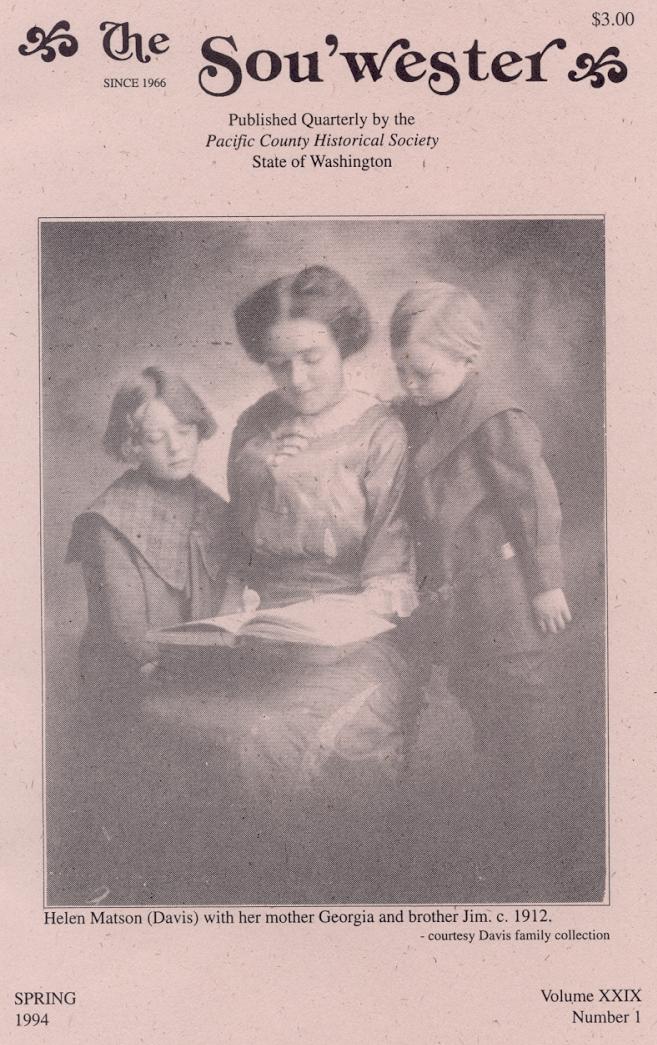
A Non-Profit Organization Annual membership fees (includes membership and Sou'wester subscription) $15.00 single $25.00 family $25.00 corporate $50.00 contributing $100.00 benefactor One-time membership fee (includes membership and Sou'wester subscription) $500.00 life member Address: P.O. Box P; South Bend, WA 98586 Pacific County Historical Society welcomes articles relating to Pacific County. Materials accepted for publication may be edited. Reprinting of any material requires permission from the Society. Second class postage paid at South Bend, Washington. All rights reserved. PUB. No. ISSN-0038-4984 Our Cover
|
||||||||||||||||
 |
|
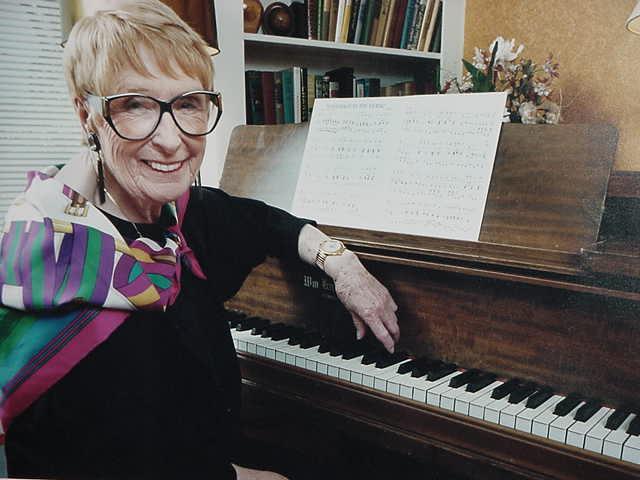
Helen Matson began her life in Zanesville, Ohio, on November 18, 1905, daughter of an Irish couple who cherished both music and education. When she was three years of age, her family moved to Denver and, within a year, Helen began piano lessons. By the time she celebrated her tenth birthday, her free-spirited family had moved to the Okanogan country of Washington State where Helen spent hours horseback riding. She also continued her piano playing, often accompanying a group of old fiddlers. When she was a senior at Riverside High School, she met a young eighth-grade school teacher who was later to become her husband. After graduating from high school in 1923, she moved to Bellingham and completed one year as a music major at Bellingham Normal College (now Western Washington University). The same year she and Chauncey Davis were married and moved to Long Beach. They remained there until 1934 when Chauncey accepted the position of Pacific County Superintendent of Schools whose office was in South Bend. He later became Superintendent of South Bend School District, a position he held until 1952. After retiring and settling permanently in South Bend, Chauncey established the Davis Insurance Agency. In the 1960s, Helen added the Real Estate Division and was to remain an active member in the business until her death. She had been married 56 years when her husband died in 1979. |
Helen wrote
many musical compositions during her lifetime.
This included an operetta, "Eliza and the Lumberjack"
which has been performed throughout Washington, also in
Klamath Falls, Oregon. In July 1989, the Tacoma
Little Theater had eight sold-out performances.
Many thought her crowning achievement was in 1959 when
the Legislature designated her "Washington, My Home" as
the official song for the State of Washington.
|
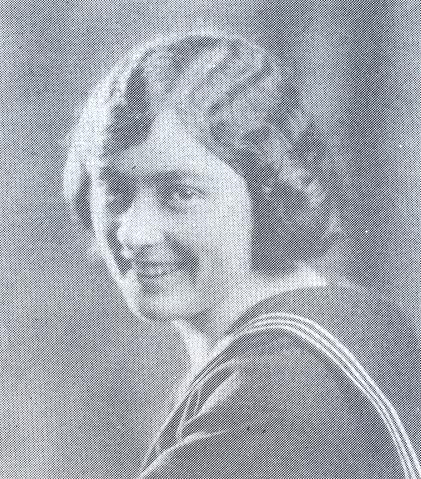 Helen Matson in 1921-22. - courtesy Davis family collection
|
||||||
|
Given by Rose Fischer at the Services Last month Helen was nominated for two of the state's most prestigious awards
|
|||||||
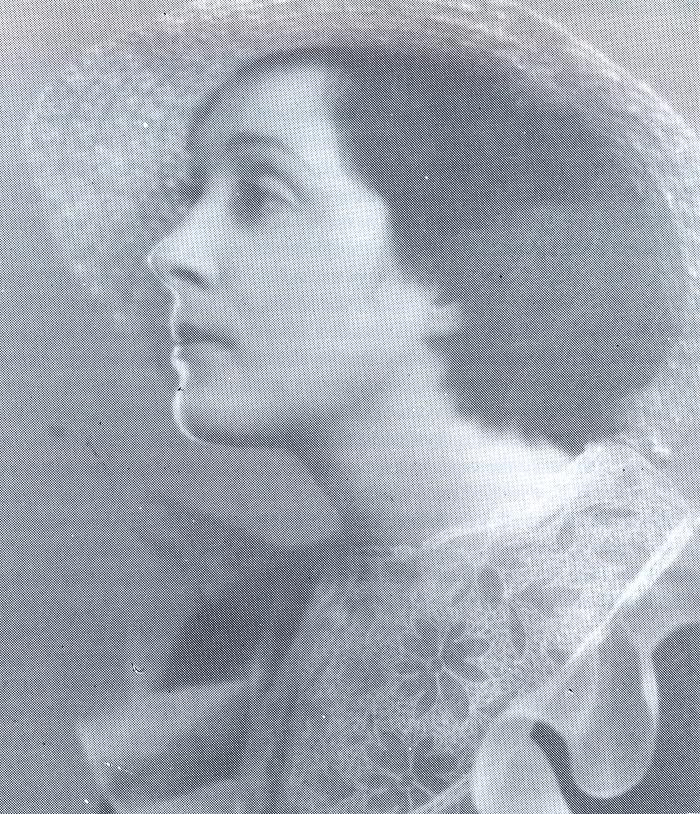 First production of ELIZA, staged in 1949: Helen Davis in the leading role. - courtesy Davis family collection
|
| Helen's last
public performance was at a Christmas party in Chehalis
for over 300 people. They loved her. She
autographed programs and delighted everyone. At
the time I never thought I would be standing here
talking about Helen in the past tense. Somehow I
just believed she was forever, immortal, too full of
life to leave. But what a legend she has carved
and what a legacy she has left to each of us. Petite, a bit of a ham, saucy and outspoken, Helen was a Northwest institution. During her long career, she wrote three musical plays:
Modern, stylish and full of zest, Helen loved to cut up as well as dress up. Young girls came to her and said, "Keep wearing those outlandish clothes, Helen, you give us hope." She noticed everything. Her memory was phenomenal. She had a keen perception of people and could quickly cut to the bottom line. Helen was rarely without an opinion on anything, yet she was also a good listener. She took criticism good-naturedly, usually making a joke of it. She seldom shoed discouragement, only a longing in her voice and words betrayed concern. |
| She had little
regard for waiting. She did what she wanted.
Along with a powerful independence, Helen also possessed
great sensitivity and intuition. She refused to
accept her age. "I don't see why the numbers are
important," she laughed. "I'm gettin' along.
Age is just a matter of opinion." Sometimes she
caught us off guard with her quick retorts, but there
were no lags or lulls with Helen. She was a
package of spice. Wherever she went, Helen created excitement. She was kinetic art in perpetual motion; flashy as a silver salmon jumping stream. Helen was impossible to catch. She was a free spirit who romped through our lives with the gusto of a youngster. She made us laugh and our eyes sparkle with delight. Helen was pure magic. Though she believed her work defined her, in reality it was the intensity of her spirit, that exuberant energy, that defined everything she did. The well-being of her family always came first. Reverently she said, "You have to take care of everything you touch." And secondly came South Bend. "There's no place like home," she declared. "If you don't honor your home, what are you going to honor? It's high time people become loyal to their roots." Though Helen's accomplishments are staggering, what she was is even more astounding. Helen wasn't perfect but she wasn't interested in being perfect either. Because she nurtured her individuality, she gave us the greatest gift of all; herself. She wanted to make the world a happier place. She believed that people needed to have hope. "If I've helped even one person a little, then I'm happy," she confided. "Perhaps my life could be summarized as a community effort," she wrote. But she did it her way, and in the doing left a powerful legacy. She once penned, "As to what I've don with my life, I'm no sure, but its been a fun trip." And her epitaph reflects this philosophy: And today ain't too bad either. Beloved by men, idolized and copied by women, adored by children, Helen was a tough act to follow. She touched the youth in all of us. Her lively style and spunk made even a few moments with her unforgettable. Helen had a spontaneous sense of humor, an ability for candid honesty. She was not pretentious and she never wanted to hurt anyone. When it came to differing viewpoints, she accepted them easily and with grace. She often kidded, "I have no opinion; now go out and do likewise." Helen loved people. "They're more important than anything else," she remarked. "I've never met a person I didn't like; but sure would love to fix some of 'em up." Though her life was not all humor and fun, Helen didn't dwell on misfortunes. She didn't like to think about the bad times. She took both success and failure in stride. When asked how she broke her hip, this teetotaler quipped, "Stumbled on the sidewalk right in front of the tavern; maybe I was a bit tipsy." |
| Helen made
encouragement a personal mission. Daily she spoke
words of support to those she met. Believing that
"if it's to be, it's up to me" she usually took the
initiative with people as well as projects. Her
big heart was legendary. To be hugged by Helen was
to be wrapped in the warmth of total acceptance.
It's little wonder that we could never get too much of
her. Since she claimed she was poor at numbers,
she never kept score. She just gave and gave and
gave. Her song "Rainbow World" says it all:
And tie it with a great big bow And then we'll give it to the people Because it's really theirs, you know |
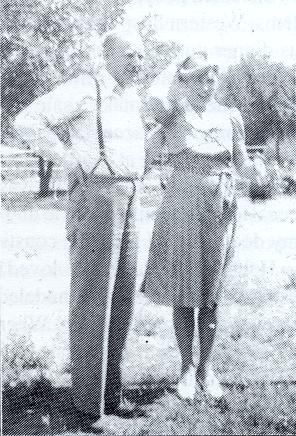 Helen and Chauncey Davis in Long Beach, circa 1930. They lived there until 1934. - courtesy Davis family collection
|
So many
persons were affected by the life and death of
Helen. Jean Shaudys, a longtime friend in
South Bend writes:
I cannot remember a time I didn't know Helen Davis. I remember the Sunday afternoon my family walked up the hill behind our house to watch Chauncey start to clear the trees from the property where their house was to be built, where he and Helen lived for the rest of their lives. I didn't realized it until much, much later, but she was like a second mother to me. She watched me grown up; from a "tom boy" childhood, through the teens, high school, and college years. |
|
I took a lot of trips with Helen. One of the most memorable was in 1920 when our two families went on an automobile trip to Okanogan and British Columbia. We spent a week in the Okanogan country, and Helen introduced us to the friends she had known when she lived there as a girl. Everywhere we went she invited people to come up to our camp for dinner the following Sunday. The Saturday night before the dinner, my mother couldn't sleep for worrying. According to her, our food supply was down to bread, two cans of Spam, and a rabbit Chauncey had shot. But the next day when the guests began arriving, all was well. It was obvious that Helen knew her friends and vice versa. Every guest brought food; fried chicken, homemade ice cream, garden vegetables, homemade bread, fresh churned butter; all kinds of food! |
 |
Helen would talk occasionally of how little her parents had when she was a girl in Okanogan and how, when she was in high school, she would play the piano at the brawls which passed for Saturday night dances to help pay for clothes. Later in the early 1930s, she and Chauncey played at dances at Long Beach to earn extra money to pay for treatments for their very ill little girl, Ruth Ann, who died before the move to South Bend. |
Ann Mergens of
Raymond expressed her feelings this way:
Helen Davis was an institution in South Bend. Stranger was a foreign word to her. She knew everyone. Everyone knew her. At her age, she could have easily slowed down a little bit, but not helen. She was still going strong at Davis Insurance and Real Estate up to the time of her death on December 31, 1992. |
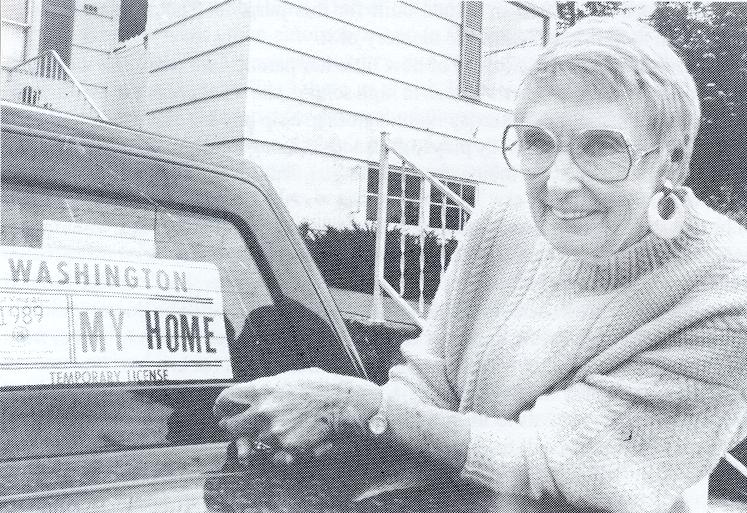 Helen Davis, by her new temporary license plate which was a gift from her family. - courtesy Davis family collection
(photo by Juli Bergstrom)
|
Ray D. Spurrell,
Mayor of South Bend, knew Helen well and added these
comments:
A great lady, Helen Davis, has left us! Her faults are written in the sands which are washed clean with every tide; her virtues on the tables of love and memory. Our community will never forget the boundless energy given freely to all who knew her. Her music was her life and her memory will be carried on in "Washington, My Home" which is our state song. |
| Here are the words of others who knew her: |
Robert Bailey,
State Senator:
Sometimes Helen Davis got in other people's hair, and sometimes they got in hers. But they all survived and are the better for the experience. |
Bob Basich,
State Representative:
Helen was a class act with a wonderful sense of humor; a positive role-model for kids and adults. An outstanding leader. |
Bill Brumsickle,
State Representative:
This vivacious, talented lady has been the creative driving force promoting the arts in Pacific County for over 50 years. She has inspired, trained, costumed, taxied, nursed, and pushed or pulled many children and adults until a level of performance was reached that the players and community were proud of. |
Don Duncan, Seattle
Times reporter:
Helen had a remarkable energy and ability to get things done. One of her favorite expressions about South Bend was, "Oh, we're on the move all right." Helen liked to shock, to laugh and to gossip. Above all, she liked to live life to the fullest. I would include Helen in that small number of creative people who soak up impressions like a sponge and then, after infusing them with their own special magic, give them back to us as something to be treasured. |
|
by Thomas O'Neil "I was born in Aberdeen in 1920, moved to Tokeland with my parents and two younger brothers in January, 1927. My father planned to build a cabin camp and bought a square block of land in Hollywood Addition. By the time he had built two cabins and our home with room for a small store in front of the ground floor, the depression hit and tourism virtually disappeared. However, my parents had the opportunity to acquire the store in the main part of town, and my mother became postmaster. "From the front of the store building, you will notice the end ot the right is a one story ell. This ell was originally a part of the "Castle Crags" house across the street. During the second big store, circa 1932-33, that house was washed off its foundations. My parents bought it, moved the back kitchen part across the street, and we used the house as a garage until my mother sold the property in 1946. |
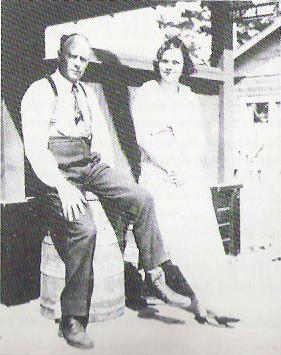 Eva V. and Frank L. O'Neil sitting on an ice cream barrel in front of their Tokeland store in the early 1930s. - Courtesy Thomas R. O'Neil
|
| "I
went to Tokeland School from the 2nd through the 8th
grades and attended high school at Ocosta. My
father died in 1937, the fall after I graduated from
high school. I spent the next five years operating
the store and post office with my mother. I then
joined the Coast Guard and spent the better part of the
next three years stationed across the bay at the Coast
Guard Captain of the Port unit in South Bend." Mr. O'Neil supplied another bit of history regarding the Tokeland School. Not long after the second room was added to the schoolhouse, a second larger playshed was built at the east end of the lot. The builder was Bill Jacobsen, now of Raymond. He lived much of his life in North Cove and has contributed much data on that area which is on record in the Pacific County Museum. |
|
| Mr.
O'Neil continues: "The rest of my life, I have
lived in Washington and Oregon. After retirement
my wife and I spent five years traveling full time in
the United States and Canada. In 1990, we retired
from traveling and presently live in Tumwater,
Washington." The following stories written by Thomas O'Neil add much to the history of Tokeland in the 1920s and 1930s. Our thanks to Mr. O'Neil for sharing them with the Pacific County Historical Society. |
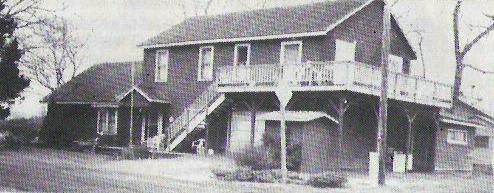 Above photo of The Tokeland Store today, showing the ell added after the storm of 1932-33. - Courtesy Thomas R. O'Neil
|
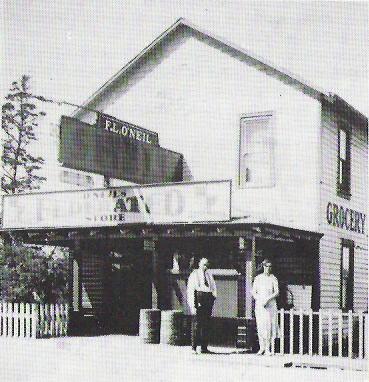 Above photo shows Frank and Eva O'Neil in front of their Tokeland store, early 1930s. - Courtesy Thomas R. O'Neil
|
|
|
|
|
| Growing up in Tokeland Just after Christmas, 1926, the O'Neil family (father Frank L., mother Eva Victoria, and sons Thomas E., Charles A., and Robert G.) moved to Tokeland. Father had recently bought a second-hand Model T ford pickup and either built or had built a canopy of wood frame covered by tarred canvas. Father and mother had purchased from the Kindreds a square block of land in Hollywood Addition. We arrived in Tokeland after dark and moved into the Johnson house, just adjacent to the newly purchased property. This house faced the bay. There was a row of driftwood 75 to 100 feet between the front of the lot and the sandy beach. In those days many logs were lost out of log booms, mill waste was dumped in the rivers (there was no use for wood chips then) and added to this were trees of all sizes that had been washed out of the river banks and the bayside. My parents had spent the previous three years working for my father's brother, Goldwin, at his large summer resort on Newman Lake near Spokane, Washington. When the resort was sold in the summer of 1926, my parents were out of a job. The move to Tokeland was planned for the purpose of starting a small cabin camp (the word "motel" had not yet been coined). |
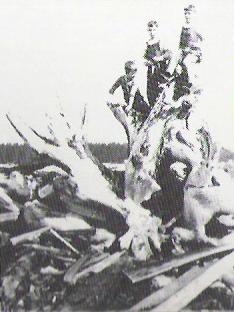 Bob, Charley and Tom O'Neil playing on driftwood at Tokeland about 1930s. - Courtesy Thomas R. O'Neil
|
| The
first order of business was to build a home on our
property. Both father and mother had worked at
Grays Harbor Shipbuilding Company in Aberdeen during
World War I, in fact that is where they met. A
co-worker of my father's from the ship building days,
Ernie Friend, lived in Grayland and he recommended Andy
Huffaker as a carpenter. In the center of the property, fronting on the county road, a space was cleared of the 6 to 8 foot tall huckleberry and salal bushes and a few scrub pines. The two-story house, which is still standing, consisted of a large kitchen / family / dining room and a room in the front to serve as a small store and office for the soon-to-be cabin camp. An alcove off this front room, under the stairwell, contained a small heating stove with a register in the ceiling to allow heat to flow upstairs to the two bedrooms on the second floor. There was no plumbing or electricity in the house. Power lines were not extended to Tokeland until after World War II. A well point attached to a 1½" galvanized pipe was driven 8 or 10 feet into the sandy ground and a pitcher pump on top served as a water supply. A one-car garage was constructed on the west side of the house, and the outside was built just behind the garage; a white enamel chamber pot with a lid served our nighttime needs. Later, father bought a second-hand 32-volt Delco light plant. Nothing new was ever purchased unless it couldn't be found second-hand. Melvin Alvey, a Coast Guardsman from the station at North Cove, installed the light plant and wired the house, knob-and-tube wiring along the ceilings. |
|
| By the time
father had constructed two three-room cabins, the
depression had hit. Meanwhile, we had put in a
small inventory of basic groceries which brought in a
small income. To supplement the income, mother had
started baking bread in the oven of our wood range,
three loaves at a time, and selling them. Our best
bread customers were the Indians from Georgetown.
They loved the warm bread just out of the oven and often
never god them home, just going out the door and
consuming a whole loaf before getting in their cars.
We all lived close to the beach which provided quite an extensive sandbox for younger children. during the twenties and thirties, a hard-packed sand beach extended all the way from the point at Tokeland to within a short distance of the Georgetown Reservation. Automobiles could be driven this full distance at low tide. |
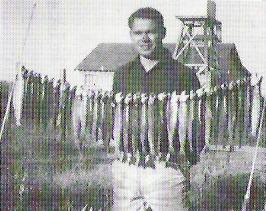 Tom O'Neil stands behind a string of blueback trout, the result of a fishing trip on North River around 1940. - Courtesy Thomas R. O'Neil
|
|
Beachcombing was always interesting. Many more
glass floats came in with the tide in those days.
Other finds included pieces of cork from life
preservers, bamboo canes up to three inches in diameter
(bamboo was used to help tie down deck loads on
freighters from the Orient and was thrown overboard as
the ships were unloaded), bottles with Japanese letters
imprinted in the glass, and odd-shaped driftwood.
Roaming the beach was always a fun pastime. As in most families during the depression years, my two brothers and I each had one pair of shoes. The shoes had sturdy leather uppers but the natural rubber or leather soles did not wear well compared to today's shoes. Getting the shoes half-soled meant that we had to wear our rubber boots or go bare-footed while the shoes were sent to a shoe repairman in Aberdeen. Someone told my father about Carl (Karl) Sanders who was a shoemaker in South Bend. My father and Mr. Sanders made an agreement which was to last for several years. Father would meet the morning ferry on Saturday when it arrived in Tokeland. He would send three pairs of packaged shoes to Sanders who met the ferry on its return trip to South Bend. BEcause the shop was on Water Street near the ferry landing, he was able to repair the shoes in time to send them back to Tokeland on the late afternoon ferry. This arrangement worked very well until we boys were grown. When I was in the Coast Guard stationed in South Bend, I needed a pair of shoes half-soled. As Sander's shoe repair shop was still open for business, I brought my shoes in and told him who I was. He turned the shoes over, looked at the soles and said, "You're the oldest son, aren't you?" I said, "How did you know?" He replied, "Well, each person wears out the soles differently and this is like a fingerprint to a shoemaker. Besides, as you and your brothers grew, your two brothers overtook you in shoe size until the youngest had the biggest feet, the middle brother was the next biggest, and your feet were the smallest." Sanders, who had never seen any of us, had gleaned this information while tearing off the old soles and replacing them. I think he was a man who loved his work. |
|
|
The fall after we moved to Aberdeen, I was enrolled at the A. J. West Elementary School. The staff decided that as I had spent only about 3½ months in the first grade, I would be enrolled in the first grade again. The problem was that I knew everything that they were teaching and because of that, I was a deportment problem. When we moved to Tokeland in January, Mrs. Waite, the teacher, was informed by my father that she would most likely have to watch my discipline. She pulled a couple of books out of the bookcase, had me read them, placed me in the second grade, and there was no discipline problem. Mrs. Waite had formerly taught at the North Cove school. She was the wife of S. L. Waite, an insurance agent in South Bend. She came from South Bend each Monday morning on the ferry, stayed at Kindred's Tokeland Hotel during the week, and after school was out on Friday returned to South Bend on the ferry. The ferry dock at that time was out on the point just south of today's old Coast Guard boathouse. One stormy Monday morning Mrs. Waite wasn't at the schoolhouse when we students arrived. After a while, we all trooped down to the dock. The ferry Independent was trying to get into the ferry slip, but each time it approached, the wind would take it off course. Finally it gave up and we all waved to Mrs. Waite as the ferry took back to South Bend. Our family lived over a mile from school. There was no bus as such. Bill Dibkey who raised beef and dairy cows at North Cove delivered milk daily to Tokeland in a Ford pickup truck. He contracted with the school to haul the children from Georgetown Reservation to school in the morning in the back of his pickup with the milk. I was the last one on in the morning. At night we all walked home. The Tokeland school in 1927 had only one room but it was not the original Tokeland school. A building some fifty feet east of our school was the woodshed which had been the schoolhouse, probably the original one. There were patches in the siding of the woodshed where windows had been removed when it was converted. |
| Our schoolroom
had no lighting and I often think about how dark it must
have been on inclement winter days. There were
windows along the west end, some small windows up high
above the blackboards on the north side, and two
fair-sized windows on the south side. There was no
water available for drinking, washing hands, etc.
That's just the way it was. About a year after we had moved to Tokeland some of the mothers who had children in school approached my mother and asked her to run for a position on the school board. These mothers felt that there were too many students for one teacher, and that a second room and teacher should be added. After considering for a few days, my mother consented to run. Being a newcomer, she did not realize that the incumbent, Mrs. Elizabeth Kindred, had been on the school board for many years, possibly since Tokeland's first school opened. At any rate, after the election was over, the race ended in a tie, 31 to 31, I believe. By this time my mother realized who her opponent had been and that it was probably a blow to Mrs. Kindred's ego to have a rank newcomer tie her in the election. Mother went to see Mrs. Kindred and proposed that she would concede the election if Mrs. Kindred would agree to the second room on the school building. Although the Kindreds paid by far the majority of the taxes collected in the district, Mrs. Kindred readily agreed to this. She and Mrs. O'Neil were good friends from then on. In the summer of 1928 the second room was added onto the east end of the existing building and Mrs. Edith Nelson became the new teacher. Mrs. Waite taught the first four grades in the new addition and Mrs. Nelson taught the higher grades. After a year or two, Mrs. Waite retired and a young teacher, Miss Marie Gardlin, a native of Ilwaco, came to teach the primary grades. Miss Gardlin later married John Smith who was in the Coast Guard at North Cove. John's father and grandfather were early settlers of North Cove. After Mrs. Kindred died in 1931, my mother served many years as chairman of the school board. In the small town, single women teachers were under constant scrutiny of the gossips. To avoid the turmoil these gossips created, Mrs. O'Neil proposed to her fellow board members that they hire married couples. This not only silenced the gossips but provided additional excellent teachers. In the 1930s most school districts would not hire a woman teacher if she were married. Tokeland profited from this, having their pick from the many applications from married couples received each year. Students who attended Tokeland School from 1927 to the early 1930s are listed in the box on the next page. These include the children from the Shoalwater Indian Reservation, or "Georgetown" as it was called by those who lived in the area. |
Those who attended school received a basic education: Reading, writing, arithmetic, grammar, history, geography, and spelling. In order to graduate from the eighth grade, a student had to take a state test in each of the various subjects, including agriculture. The subject of agriculture was tough on both the students and the teacher. Some people had small gardens and the only farm was at the Tokeland Hotel where the Kindreds had about four milk cows, a heard of beef cattle, chickens, and turkeys. They also had a garden and harvested native hay for their livestock. Outside of selling a few beef cattle, all of their produce was for use at the hotel. The children of fishermen, clam diggers, etc., had virtually no contact with any aspect of agriculture. But we had to learn about rutabaga, Holstein Friesan cows, Poland-china pigs, etc. We found it far from interesting. In 1927 the school consisted of four structures: the one-room school building with a bookroom-size closet, a small woodshed, and out in back two privies, one for the girls and one for boys. At about the same time the second room was added in 1928, a small playshed of approximately 15 feet by 30 feet was also constructed, and a few years later a larger playshed of about 20 feet by 50 feet was added. The smaller shed was reserved for the smaller children. |
| At recess and
during the noon lunch break, we played outside, rain or
shine. After the playsheds were built, there was
some protection from the weather. Since we had
little or nothing in the way of playground equipment, we
played games like tag, kick-the-can, and pom-pom
pullaway. There was one swing, the rope hanging
from a tree limb. During better weather we played baseball, or rather, sponge ball. Someone would bring a ball to school and somehow we would obtain a bat. Occasionally the girls would play ball but usually it was all boys, and we reached down as far as the third or fourth grade to have the ten to twelve players needed for a game. Sockout-workup was the usual game. To get a runner out, you could force him out at base or hit him with the ball whenever he was between bases. There was no restriction on what part of the body you hit. The younger players spent most of their time in the field. There were three batters and the rest of the group worked their way up the field. Whenever a batter was put out, he went to the outfield. AS outs were made, a player moved gradually from the outfield to third base, then around the bases, eventually to pitcher and then catcher from where he replaced the next batter that went out. Since the older boys were naturally the better players, they usually spent most of the time as batters, and when one of the younger players finally worked his way up to being a batter, he was most often put out on his first time at bat, then returned to the outfield to work his way up again. Usually, at each recess or lunch hour, we resumed the same position at which we had been playing on the last previous game time. Each player served his apprenticeship in the younger years and gradually became more proficient as he aged. Naturally, batting and running the bases was the most fun. Some of the other things we did to amuse ourselves included hoop rolling, mumble peg, marbles, and ole-ole-over. Hoops consisted of wheels off toy wagons or other toys, or the cast iron lids off old cook stoves. A device for rolling consisted of a handle of a small board or whittled wood with a wooden crosspiece, about eight inches long, nailed across the end at right angles. Stove lids with their sharp edges wore out the handles quickly. The challenge in hoop rolling was to keep the hoop rolling while making sharp turns and other maneuvers. Mumble peg (mumblety-peg) was played with a jack knife but not very often for lack of ownership of a knife by most of us kids. Usually, two players competed. The game consisted of a series of ways of throwing the knife to make it land with the point stuck in the ground. If the pointed end of the knife blade stuck in the ground and you could slide one finger between the end of the handle and the ground, the throw was legal. The first throw was to hold the knife point between the thumb and the first finger. The next six moves were: Using each finger in turn with the thumb, flat in the palm of the hand, and on the back of the hand. Other following throws were done by resting the handle end on the chin and on the end of the nose. For those brave enough, the non-throwing hand was laid flat on the ground with the fingers spread. The knife was then flipped into each of the spaces between the fingers. Players continued through the routine series of moves until one was missed. Another player took over until he missed, the players continuing to alternate turns in this way. Seldom did time allow them to reach the more dangerous moves. |
| In
ole-ole-over, the players were divided into two teams,
one team on each side of the playshed. A sponge
rubber ball was thrown over the roof by the member of
one team while that team, in unison, shouted "ole, ole
over." When a member of the team on the other side
caught the ball, he ran around the end of the shed with
the rest of the team streaming behind him. The
object was to throw the ball and hit a member of the
opposing team which had started running around the
opposite end of the shed as soon as they realized that
the other team was coming. If the ball was not
caught, it was thrown back over the roof, from one side
of the shed to the other, until someone caught it.
In ole-ole-over, the best strategy was to hit the older
players as the player who was "it" had to become a
member of the opposing team. As the older players
were claimed, the team's ability was strengthened while
the opposing team was weakened. Marbles was a fair-weather game. When players played for keeps rather than fun, the winning player accumulated more an more marbles. There were several variations to the game but the main order of business was to shoot marbles out of a ring. Two or more players "anted" a like number of marbles inside a round ring circumscribed by a shallow groove in the ground. Each player lagged his shooter from a line several feet from the ring and the player whose marble stopped closest to the ring shot first. The distance from the ring determined the order of the other shooters. The player had a choice of knocking marbles out of the ring by hitting them with his shooter and claiming these marbles as his. His other option was to hit an opponent's shooter and drive it further from the ring. The better players selected their poorest marbles for the ante while less adept players had to anti better or oftentimes new marbles. As I remember, the best marble players were Fred Shipman and, later, his younger brother, Art. They each accumulated fruit jars full of marbles. The various activities mentioned above required very little cash outlay for equipment. The school did not have the funds to make such purchases and neither did most of the students or their families, especially after the depression hit in 1929. Marbles were the biggest expense, particularly for the poorer players. Steelies (ball bearings), aggies (expensive marbles made from agate rock), and glassies (made from glass) were the common items. Glassies made up the big bulk of those used and a small bagful could be purchased at the local general store for five or ten cents. Our world was small. There was not nearly so much to learn about as children are faced with today. We received practically no training in art or music but those who wanted to receive as good an education as students who attended larger schools could get one there in Tokeland. Paul Hitchcock, a former superintendent of the Ocosta Schools, once told me that the Tokeland students who went on to Ocosta High School were all well prepared. |
|
Mrs. Elizabeth Kindred, who you might say was the queen matriarch of Tokeland, greeted my father as a new resident of the community. She took us into a lounge off the main dining room to show us her large collection of Indian artifacts made by native Americans from Alaska to the Southwest desert. She enjoyed pointing out each one, explaining where it came from, and who had brought it to her. The home of Lizzie's parents, the Browns, and later the Kindred home which became the Tokeland Hotel, ahd long been a stopping-off place for travelers arriving by boat from South Bend or Oysterville, or by stagecoach from Westport. Many of these were traveling salesmen who had large territories in the sparsely-populated west. In appreciation of the gracious hospitality of the Kindreds, they picked up these baskets or other items in various places and brought them to Mrs. Kindred as gifts. The Tokeland Hotel raised a great deal of the food that was served. In the early 1930s, it was great fun for me to go over to the hotel and follow around their hired man. John West, who was a small man of Swiss descent, was not married. I recall eating in the community dining room just off the back of the kitchen when Jon West invited me to eat lunch with him. Ten or fifteen people were seated at the table, food served family style. I had never seen such an array of delectable food before and don't know that I have since. About one hundred yards directly west of the hotel was a red barn where John milked four or five cows, morning and night. The Kindreds had a large herd of beef cattle that roamed over the unfenced countryside, land owned mostly by them. There were six or eight chicken pens and houses just west and adjacent to the present road, to provide eggs, fryers, and roasting chickens. A flock of forty or fifty turkeys, used as a supplement to the larder, also roamed loose. The Kindreds grew a substantial garden which included a large field of potatoes. Extending west and immediately adjacent to the north end of the hotel was a shed which was used as a pantry for canned goods, also a milk house where the milk was poured into large shallow pans so the cream could be skimmed from the top. Another building, now demolished, was used as a tool house. Originally the home for the Browns, it served as a place for overnight travelers to sleep. The Kindreds had two daughters, Maude and Bess. Bess Miller and her husband had no children. They lived in Tacoma. Maude was never married and lived in Tokeland all her life. When we moved to Tokeland, she and George Dever, Jr. of South Bend ran the post office and general store until 1929 when my parents bought the Johnson store. At that time, my mother became postmaster. The hotel was a tourist mecca for many families from Aberdeen, Hoquiam, other northwest cities, and as far away as southern California. Some of these families booked rooms for the entire summer season. Tokeland was a wonderful recreational place for both children and adults. In those days they beach was much better than it is today. At low tide the exposed sandy flats extended out at least a half mile beyond the high-water mark. When the warm sun baked this sand and the incoming tide washed over it, the water was a nice warm temperature for swimming. Tokeland, situated about five miles inland from the ocean, rarely had a foggy or overcast day in the summer. In addition to the long beach, there were several trails inland. These included the old stagecoach road which wound through the unfenced land on the north side of the peninsula, all owned by the Kindreds. A man named Mickey McGuire had a horse-renting concession at the hotel and people road the horses on these trails as well as on the beach. |
| The Kindreds celebrated their golden wedding anniversary at the hotel in 1930. Within a year, Lizzie Kindred died and her daughter, Maude, took over the reins with the assistance of her aging father. But as the result of the depression of 1929, most of the summer tourist business disappeared. Maude, together with Ralph Harrington, put in a nine-hole golf course on the land north of the hotel. A boarded-up building known as the old pool hall had been sitting on the main road about one-fourth mile east of the hotel. Bill Dibkey and Dick Jacobsen of North Cove moved the building by using their two teams of horses and several men. Planks were laid and the six-inch wooden rollers placed under two beams beneath the building allowed the structure to roll on the planks. A crew of men were continually carrying the planks and rollers forward as the horses pulled the building along. Once in place, it was refurbished and became the clubhouse for the golf course. The building has since been added onto and for years operated as Cap's Tavern until it was sold and became an art studio. The golf course apparently was not a financial success as it lasted only three or four years. |
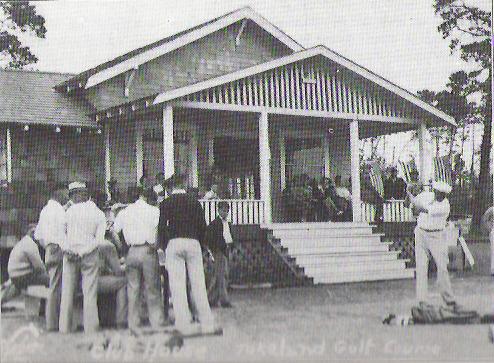 Club House for the Tokeland Golf Course, circa early 1930s. - PCHS 94.11.1
|
|
When the golf course was built, it encompassed the
pasture that had been used for the four or five milk
cows kept at the hotel. A new pasture was fenced
and a corral with water trough was located on a small
knoll just east of the back part of the clubhouse.
Beside the corral was a small white picket fence
surrounding the burial area where Albert Kindred and
what I was told at that time was his half-brother's
grave.
|
|
| Recently I was
given the name of a gentleman in Raymond who was trying
to trace down information on the Kindreds. He was
a descendant of the husband of Bess Kindred
Miller. He told me about the half-brother who was
the son of Charlotte Brown by a previous marriage.
Albert had drowned when he became stuck in the mud in
Teal Duck Slough, and the other son had died in a
shooting accident. Near the fireplace in the clubhouse-tavern-now-art studio are two tombstones. One is from the grave of Albert Brown showing the dates April 1, 1856 - May 1 1866. The other is for Leonidus Norris, born in Iowa, April 18, 1849. He obviously was the 24-year-old son of Charlotte Brown who came to Tokeland from Iowa. |
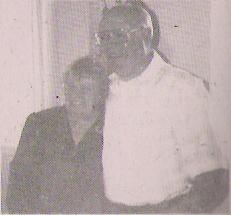 Tom and Gerry O'Neil married in Raymond, WA on June 4, 1943, celebrate their Golden Wedding in Olympia. They met at the home of Helen Davis. - Courtesy Thomas R. O'Neil
|
| At
one time there were several more tombstones at the
tavern which, I was told, were brought over from Cedar
River where the old cemetery was washing out. The
Summer Issue, 1987, Vol. XXII, Number 2 of the
Sou'wester article on Tokeland starts with the song
written in 1811 entitled "Tokeland". This is how
the composition came about. A teacher named Mae
Stewart, who taught school in Alaska for many years, had
a home in Tokeland, notable for its three-foot-wide
plate glass door. Two friends from Alaska came to
visit Mae and stayed at the Tokeland Hotel. While
there, the men wrote the song and dedicated it to
Elizabeth Kindred. Mae Stewart Taught at the North Cove School and at the Nemah School during the 1920s. Several years later, another gentleman friend from Alaska came to Tokeland and he and Mae were married. By this time both were in their fifties or sixties. It was the first marriage for Mae. Tokeland was a great place for children growing up. The only fences when I was young were a few acres fenced to hold the dairy cattle of the hotel. We hunted mushrooms or roamed around in the woods, sand dunes, and beaches. For about 1½ miles between the Shoalwater Indian Reservation and the west end of Tokeland, there were no houses, just open land for the kids and the "wild herd" to wander in. The wild herd, owned by the Indians, consisted of six to ten horses that ran loose over the countryside. Address: Thomas R. O'Neil 716 E. Dennis, #88 Olympia, WA 98501 |
|
|